mantra:imagine
mind.action.image.magic · for SATB (1–2 per part) · 2007
mind.action.image.magic · 为 SATB 而作(每声部一至两人) · 2007
Three mantras, from the Heart Sutra to ‘Coca-Cola’: chanting as canon, parody and play.
三段真言,从《心经》到“可口可乐”:以卡农、戏仿与游戏来念诵。
| Commission 委约 | The Singers Vocal Ensemble, with funds from the National Arts Council, Singapore The Singers Vocal Ensemble,获新加坡国家艺术理事会资助 |
|---|---|
| Premiere 首演 | 28 August 2007 — The Singers Vocal Ensemble, Esplanade Recital Studio, Singapore 2007年8月28日——The Singers Vocal Ensemble,新加坡滨海艺术中心 |
| Listen 聆听 | ▶ Complete recording (audio) ▶ 全曲录音(音频) |
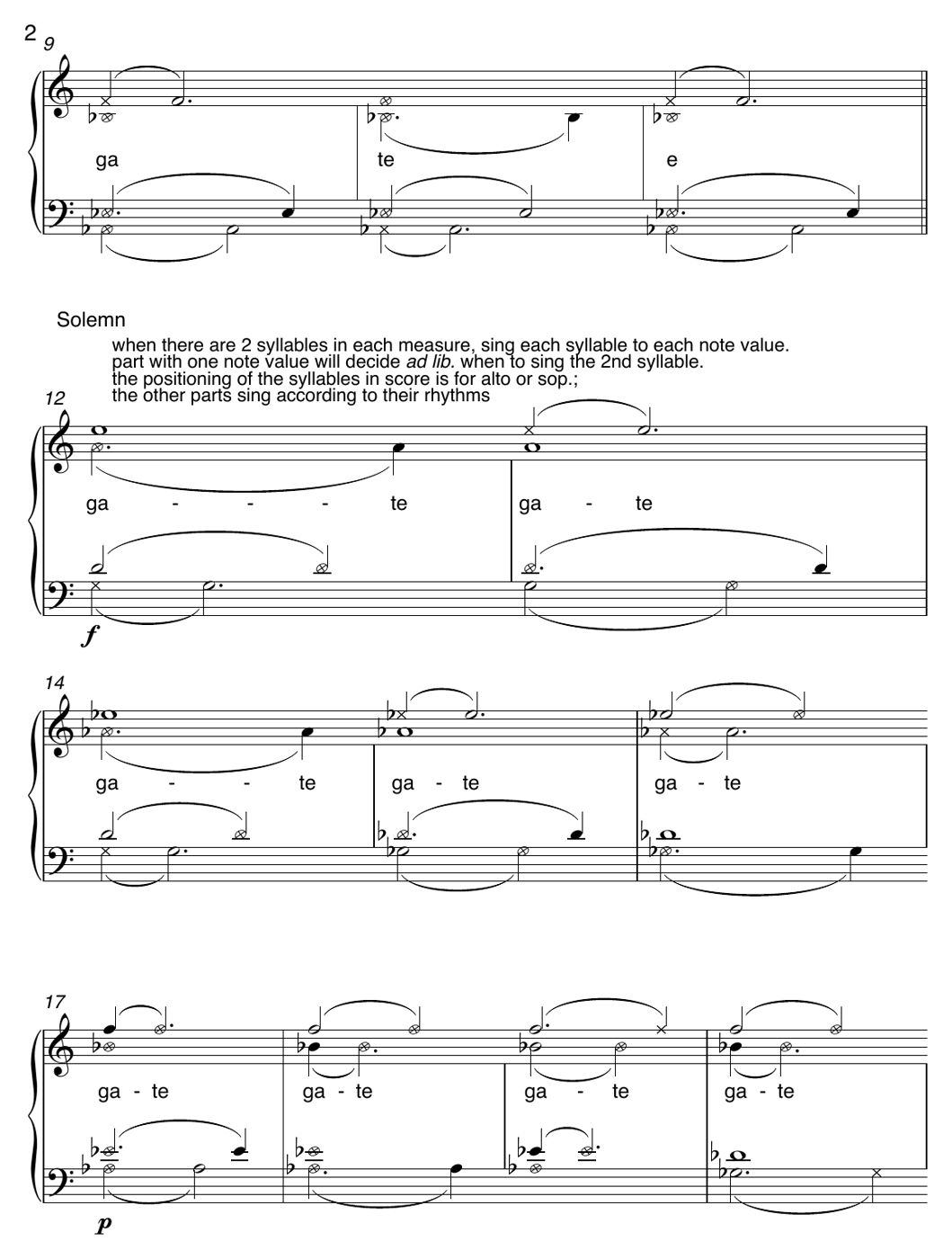
乐谱的一页。
Programme note 节目介绍
In Buddhist practice, mantras are used in chanting, where attention is focused on the sound qualities of the phonemes. The first movement uses the mantra of the Heart Sutra. While mantra texts are usually without meaning, this one can be translated, in Thich Nhat Hanh’s words, as “Gone, gone, gone all the way over, everyone gone to the other shore, enlightenment, svaha!”, where svaha is a cry of joy or excitement.
在佛教修行中,真言用于念诵,注意力集中在音素的声音特质上。第一乐章使用《心经》的真言。真言文字通常没有意义,但这一段可以借一行禅师的话译为:“去吧,去吧,一路到彼岸去,大家都到彼岸去,觉悟,娑婆诃!”——娑婆诃是一声欢喜或激动的呼喊。
The idea for the second movement’s text comes from a conversation between the Korean Zen Master Seung Sahn Soen-sa and a student, in which the Master, in his direct but humorous way, suggested that with the right focus even words like ‘Coca-Cola’ and ‘Pepsi-Cola’ could be used in chanting practice. The music is derived from the Agnus Dei I of Ockeghem’s Missa De plus en plus, an imitation mass on the tenor of Binchois’s chanson De plus en plus (‘more and more’). In my own imitation, or parody, I use techniques from all the centuries of polyphony since Binchois, connecting the dots to the present with traces of Bruckner, Stravinsky and others. In the spirit of irreverent parody, the movement is dedicated to Banksy.
第二乐章歌词的构想,来自韩国禅师崇山行愿与一位学生的对话:禅师以他直接而幽默的方式指出,只要专注得当,就连‘可口可乐’、‘百事可乐’这样的词也可以用来念诵修行。音乐取材自奥克冈《De plus en plus 弥撒》的第一段《羔羊经》——这是一部以班舒瓦香颂《De plus en plus》(越来越多)的次中音声部为基础的模仿弥撒。在我自己的‘模仿/戏仿’中,我运用了自班舒瓦以来各个世纪复调音乐的种种技法,连起通往当代的线索,其间可见布鲁克纳、斯特拉文斯基等人的痕迹。本着不敬的戏仿精神,这个乐章献给班克斯(Banksy)。
The third movement uses the mantra of Avalokiteshvara: a small canonic study of the transformations of the chain of phonemes in this six-syllable mantra.
第三乐章使用观世音菩萨的六字真言:一段关于这六个音节中音素链如何转化的小型卡农练习。
Performances 演出
28 August 2007 — premiere: The Singers Vocal Ensemble, Esplanade Recital Studio, Singapore.
2007年8月28日——首演:The Singers Vocal Ensemble,新加坡滨海艺术中心。
29 October 2009 — EXAUDI, Sound and Music’s The Cutting Edge, The Warehouse, London.
2009年10月29日——EXAUDI,Sound and Music《The Cutting Edge》,伦敦 The Warehouse。
Recordings 录音
EXAUDI 声乐团,伦敦 The Warehouse,Cutting Edge 系列,2009年11月6日
For scores, performance materials and other enquiries:
chungshih@chungshih.info
乐谱、演出资料及其他查询:
chungshih@chungshih.info