A Frog Song
for a cappella choir (SATB) · 1997
为无伴奏合唱(SATB)而作 · 1997
A Chinese children’s song sung in many tempi at once, until a stageful of frogs finds one voice.
一首中国儿歌,以许多不同的速度同时唱起,直到满台的“青蛙”汇成同一个声音。
| Voices 声部 | a cappella SATB choir, with multiple divisi 无伴奏 SATB 合唱,多重分部 |
|---|---|
| Source 素材 | the Chinese folk song Qing wa tiao xia shui (青蛙跳下水) and its variants 中国民歌《青蛙跳下水》及其变体 |
| Duration 时长 | ca. 5′ 约 5 分钟 |
| Dedication 题献 | to Jennifer Tham and Albert Yeo of the Singapore Youth Choir (February 1997) 献给新加坡青年合唱团的 Jennifer Tham 与 Albert Yeo(1997年2月) |
| First performance 首演 | 30 June 1997 — Singapore Youth Choir, Victoria Concert Hall, Singapore 1997年6月30日——新加坡青年合唱团,新加坡维多利亚音乐厅 |
About the work 关于作品
The basic material is a Chinese children’s song, Qing wa tiao xia shui (‘The frog jumps into the water’) — ‘one frog, one mouth, two eyes, four legs, ping pang ping pang, it jumps into the water’ — and its variants. The melody is repeated continuously in every part throughout the piece, although it does not sound so.
作品的基本素材是一首中国儿歌《青蛙跳下水》——“一只青蛙一张嘴,两只眼睛四条腿,乒乓乒乓跳下水”——及其变体。这段旋律在整首作品中于所有声部里不断重复,只是听起来并不像。
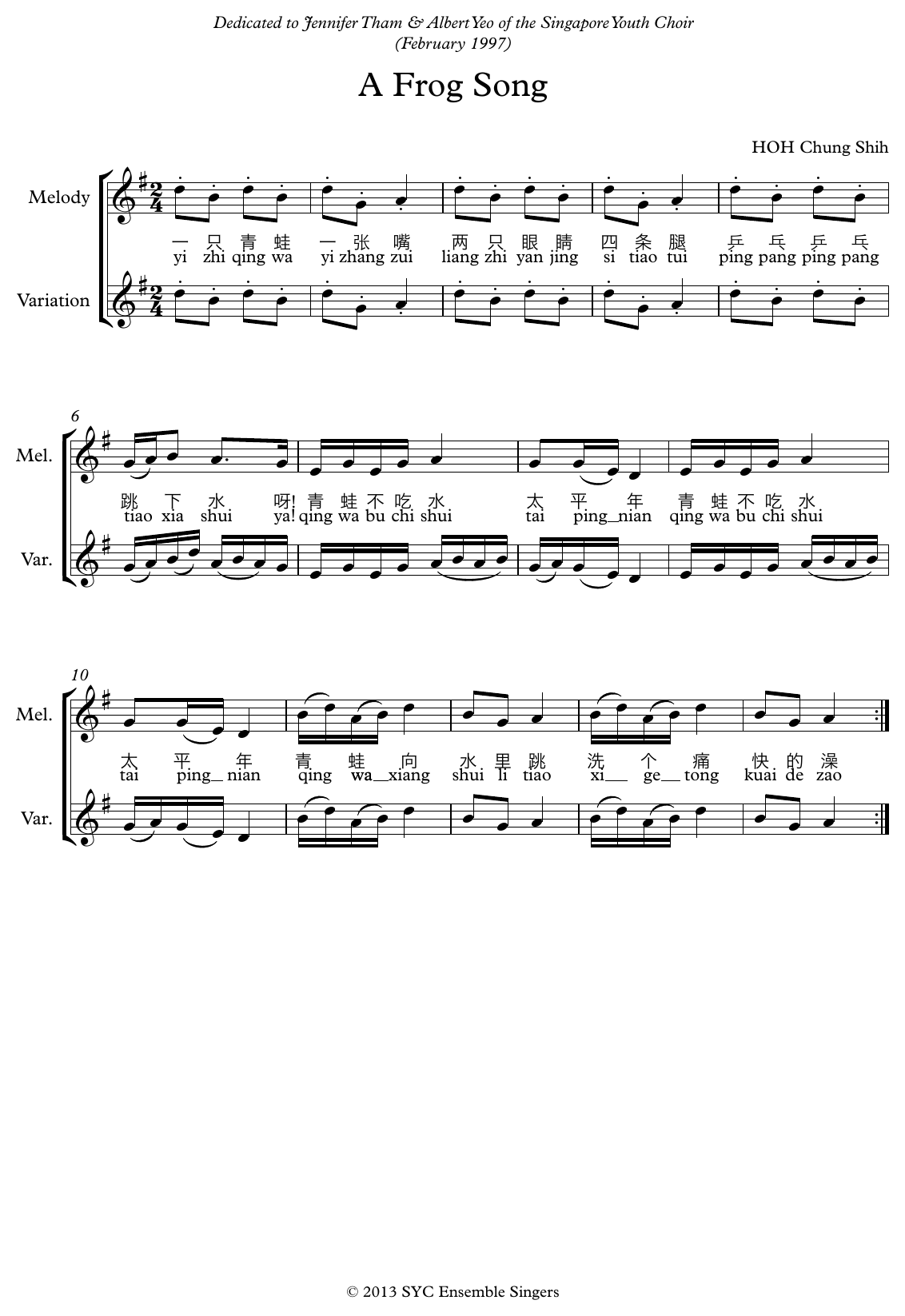
乐谱第一页:民歌旋律及其变体,附中文歌词与拼音。
In the first section each singer takes a part and enters independently, with their own tempo, expression and phrasing, while each voice section follows its own rule for picking out the notes of the tune: the sopranos sing every eleventh quaver beat of the melody, then every tenth, and so on, until the whole tune is revealed; the altos, tenors and basses work similarly from every seventh, fifth and ninth beat. Over nine sections the many tempi are gradually drawn together — first by a leader in each section, then by the conductor — through a sudden, sharp change of tempo ‘like some Balinese gamelan music’, to the brightest and loudest section, where everyone joyfully sings their own part of the tune in the same tempo. Then comes a tense, complete silence, until the conductor cues one singer to sing the first three notes of the melody, ‘innocently but with enthusiasm’.
在第一段中,每位歌者各自担任一个声部、独立进入,拥有自己的速度、表情与分句;每个声部则依各自的规则从旋律中“挑出”音符:女高音唱旋律中每第十一个八分音符拍,接着每第十个,依此类推,直到整段旋律显现;女低音、男高音与男低音分别从每第七、第五与第九拍开始,以类似方式进行。在九个段落之中,众多不同的速度逐渐被拉拢——先由各声部的领唱,再由指挥——经过一次“如巴厘甘美兰音乐”般突然而短促的速度转换,来到最明亮、最响亮的段落:所有人以同一速度,欢快地唱着各自的那一段旋律。随后是一段紧张的完全静默,直到指挥提示一位歌者,“天真而热情地”唱出旋律的头三个音。
Dynamics are shaped by the conductor, who has full freedom to sculpt the overall arc from very soft to very loud by controlling the rate of crescendo and decrescendo, and who decides the length of several sections.
力度由指挥塑造:他可以自由控制渐强与渐弱的速率,从极弱到极强地雕塑整体的走向,并决定若干段落的长度。
“The first work Chung Shih wrote for us, A Frog Song, ‘treated’ this children’s song (in Mandarin) to the processes of the New York School (Wolff, in particular) and its electric frictions that gave the magical effect of frogs gathering onstage at the Victoria Concert Hall. This was completely new-yet-old (music) in the same way Singapore as an island-city-state is.”
“仲实为我们写的第一部作品《A Frog Song》,把这首(华语)儿歌交给纽约乐派(尤其是 Wolff)的创作方法来“处理”,其中电光般的摩擦,在维多利亚音乐厅的舞台上营造出青蛙聚集的奇妙效果。这是全新而又古老的(音乐),正如新加坡这座岛国城市本身。”
— Jennifer Tham, Artistic Director, SYC Ensemble Singers; Cultural Medallion recipient
——Jennifer Tham,SYC Ensemble Singers 艺术总监,新加坡文化奖得主
引文译自英文。
Performances 演出
30 June 1997 — first performance: Singapore Youth Choir, Victoria Concert Hall, Singapore.
1997年6月30日——首演:新加坡青年合唱团,新加坡维多利亚音乐厅。
The score is published in an edition by SYC Ensemble Singers (2013).
乐谱由 SYC Ensemble Singers 出版(2013年版)。
For scores, performance materials and other enquiries:
chungshih@chungshih.info
乐谱、演出资料及其他查询:
chungshih@chungshih.info