八板芭的散曲 (Babanba)
for mixed ensemble of Chinese and Western instruments · 2021
为中西乐器混合乐团而作 · 2021
A jungle (芭) of ideas: sanqu, the eight-beat baban, and instruments of mixed origins.
一片音乐的“芭”林:散曲、八板,与来自各方的乐器。
| Instruments 编制 | Dadi, sheng, pipa, guzheng, violin, cello, piano and percussion (yunluo) 大笛、笙、琵琶、古筝、小提琴、大提琴、钢琴与打击乐(云锣) |
|---|---|
| Written for 题献 | C-Camerata Taipei, for its 2022 season 台北中央C室内乐团 2022 乐季 |
| Premiere 首演 | 18 February 2022 — C-Camerata Taipei, guest conductor Liao Yuan-Yu. crosString (回弦), C-Camerata Taipei 2022 Classic Series Concert V, National Recital Hall, Taipei, Taiwan 2022年2月18日——台北中央C室内乐团,客席指挥廖元钰。《回弦》台北中央C室内乐团 2022 经典系列音乐会 V,台湾台北国家演奏厅 |
| Performers 演奏者 | Wu Zong-Xian, dizi; Huang Long-Yi, sheng; Lin Hui-Kuan, pipa; Guo Jing-Mu, guzheng; Chang Chia-Lun, violin; Chang Chih-Hui, cello; Chien Mei-Ling, piano; Chen Wen-Ting and Chen Yen-Ting, percussion 吴宗宪(笛)、黄胧逸(笙)、林慧宽(琵琶)、郭靖沐(古筝)、张家伦(小提琴)、张智惠(大提琴)、简美玲(钢琴)、陈玟玎与陈彦廷(打击乐) |
| Listen 聆听 | ▶ C-Camerata Taipei, cond. Liao Yuan-Yu, 18 February 2022 (video) ▶ 台北中央C室内乐团,廖元钰指挥,2022年2月18日(视频) |
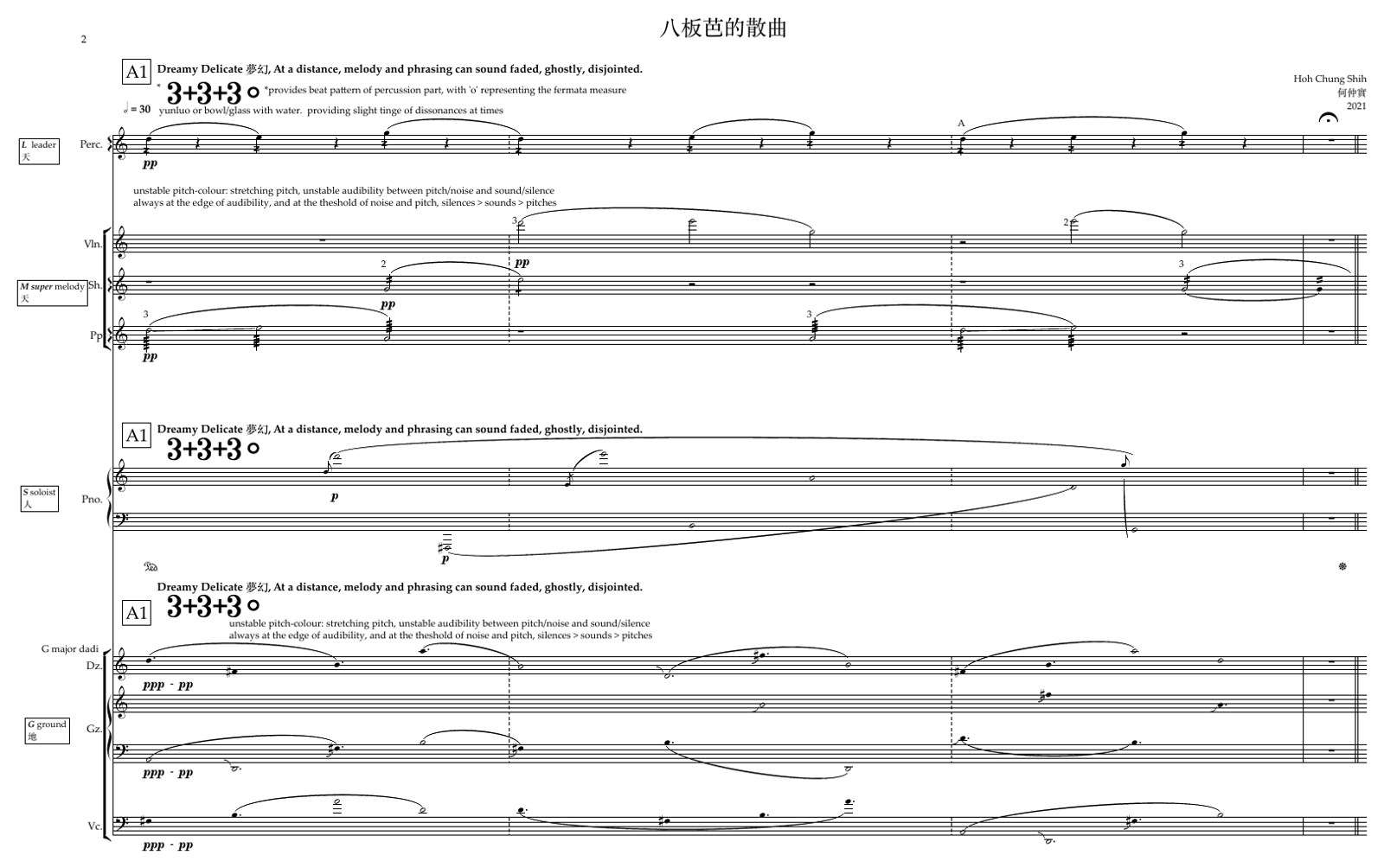
开头“梦幻、细腻”:打击乐手以定音云锣领奏,各组各司其职——旋律、独奏、底层。
About the work 关于作品
八板芭的散曲 is a jungle — 芭 — of musical ideas from the traditions of sanqu 散曲 and the eight-beat baban 八板 pattern, mashed up in an ensemble of instruments of mixed origins. The title itself plays on the sounds: ba ban, ba, sanqu.
《八板芭的散曲》是一片音乐意念的“芭”林,取自散曲与八板的传统,在一个由来自各方的乐器组成的乐团中混搭而成。标题本身也在字音上玩味:八板、芭、散曲。
The work unfolds as a series of episodes in which the instruments keep changing roles. The percussionist is always the leader (L), and the others take turns as melody (M), soloists (S) and ground (G); in the score the roles are also marked 天 heaven, 人 human and 地 earth. Much of the music is written in stemless long and short notes whose durations are relative, so the parts are not aligned beat by beat: the tension of following and answering the leader, moment by moment, gives the music its fragile nature, ‘always on the verge of forming, appearing, and breaking down, dissolving’.
作品由一连串段落组成,乐器的角色不断转换。打击乐手始终是领奏(L),其他乐器轮流担任旋律(M)、独奏(S)与底层(G);乐谱中这些角色也分别标为天、人、地。许多段落以无符干的长音与短音记写,时值是相对的,因此各声部并不逐拍对齐:时时刻刻跟随、回应领奏的张力,赋予音乐一种脆弱的特质——“总在将成未成、将现未现、将散未散之际”。
The piece moves from sparse, ghostly, dreamy beginnings to fast, noisy, chaotic music at the end. The melody is always there in the background as a guiding thread, coming into focus only in some episodes.
音乐从稀疏、幽微、如梦的开头,走向结尾快速、嘈杂、混沌的音乐。旋律始终在背景中作为引导的线索,只在某些段落中才清晰浮现。
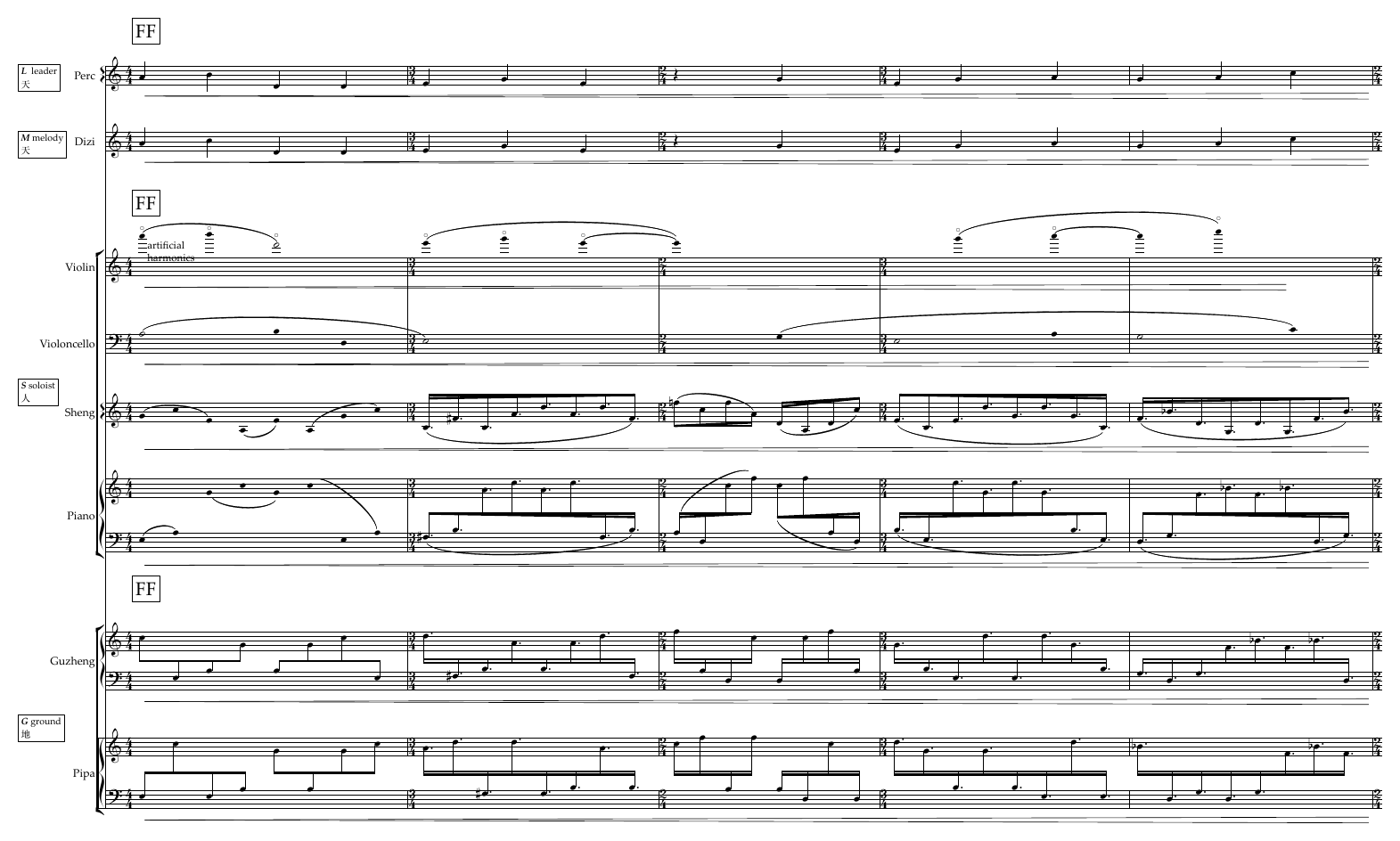
接近结尾:乐团进入快速而密集的音乐,旋律仍在底下流动。
For scores, performance materials and other enquiries:
chungshih@chungshih.info
乐谱、演出资料及其他查询:
chungshih@chungshih.info