Birth and Death
Five Songs for Thich Nhat Hanh · for mixed choir · 2004 · ca. 10 minutes
献给一行禅师的五首歌 · 为混声合唱而作 · 2004 · 约十分钟
Two characters, birth and death, make a whole poem; each singer treads their own path, like the Hani rice-planting songs.
“生”与“死”两个字织成一首诗;歌者各走各的路,如哈尼族的插秧歌。
| Text 歌词 | Thich Nhat Hanh, used with permission of the author and Parallax Press 一行禅师,经作者与 Parallax Press 授权使用 |
|---|---|
| Commission 委约 | Singapore Youth Choir, for its 40th anniversary (2004) 新加坡青年合唱团四十周年(2004) |
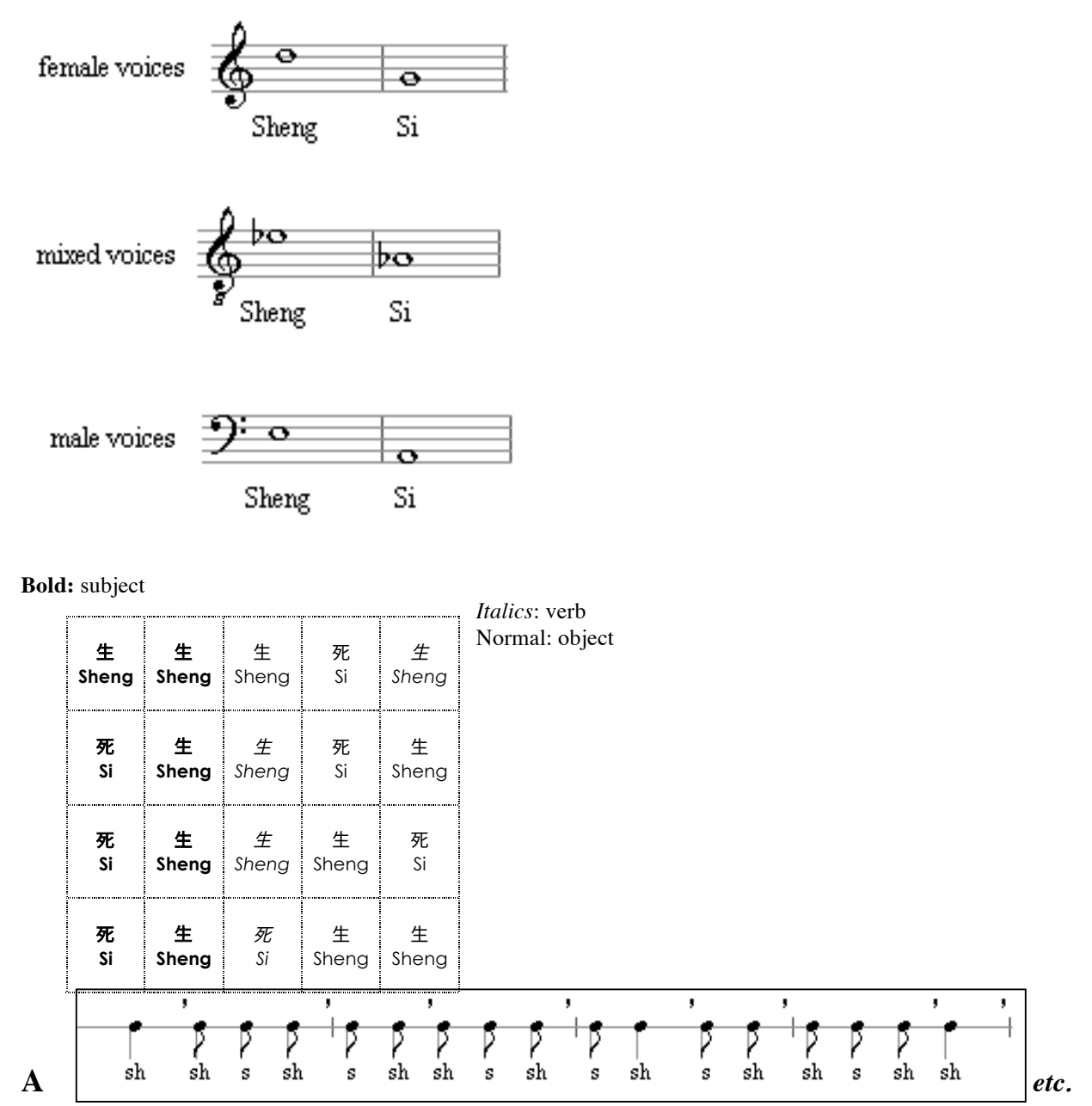
第一乐章:三组定点合唱的音高、作曲家对诗句的语法分析(主语、谓语、宾语),以及行进队伍的气声材料。
About the work 关于作品
Thich Nhat Hanh wrote this poem in 1974, at a conference organised by the World Council of Churches in Sri Lanka. The original is a repetition of only two Chinese characters, 生 (sheng: life, to be born) and 死 (si: death, to die), arranged so that they produce its meaning.
一行禅师于1974年在斯里兰卡一场由普世教会协会举办的会议上写下这首诗。原诗只重复两个汉字——“生”与“死”——经过排列,便生出诗的意义。
The music is in five movements, from about a minute to about five minutes long. It invites the choir to take part actively within circumscribed musical situations, and the staging can adapt to different spaces. Its ‘free’ polyphony is inspired by the eight-part polyphonic singing of the Hani people of Yunnan, China, whose singers describe it in this way: when one is out walking, each person treads their own path; when transplanting rice seedlings, some arrive earlier and some later — and the songs sound good this way.
音乐分为五个乐章,长度从约一分钟到约五分钟不等。它邀请合唱团在限定的音乐情境中主动参与,舞台安排也可因地制宜。其“自由”的复调,灵感来自中国云南哈尼族的八声部复音歌唱;哈尼族歌者这样形容:走路时,每个人各走各的路;插秧时,有人早到,有人晚到——歌就是这样唱才好听。
The text 歌词
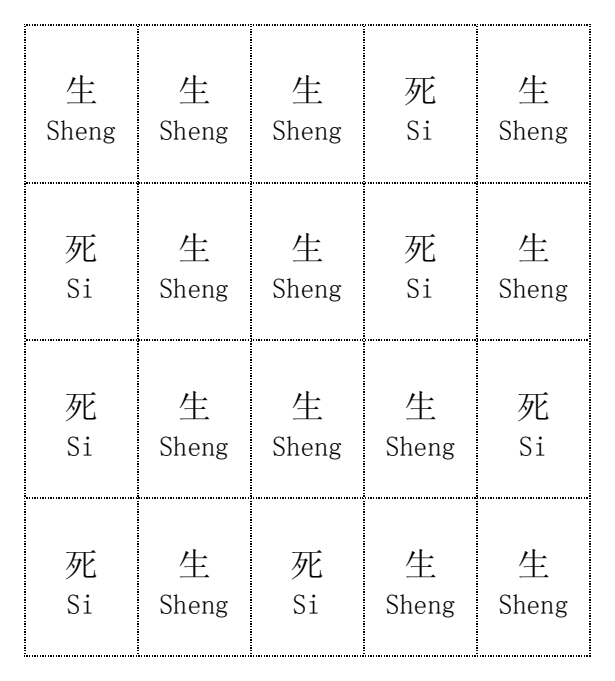
诗文:二十个字,只有“生”与“死”。
During many lifetimes, birth and death are present,
Giving rise to birth and death.
The moment the notion of birth and death arises,
Birth and death are there.
As soon as the notion of birth and death dies,
Real life is born.
Thich Nhat Hanh, from Call Me by My True Names: The Collected Poems of Thich Nhat Hanh (© 1999, Unified Buddhist Church). Used with permission of the author and Parallax Press, Berkeley, California.
原诗只由“生”“死”二字组成(见上图);以上为英译。
Performances 演出
2009 — Singapore Youth Choir Ensemble Singers. Reviewing it in The Straits Times, Chang Tou Liang praised the “ingenious treatment” of the vocal material.
2009——新加坡青年合唱团 Ensemble Singers。Chang Tou Liang 在《海峡时报》的评论中赞赏其对声乐材料的“巧妙处理”。
October 2010 — Vox humana, conductor Ryuta Nishikawa, Asian Music Festival 2010, Tokyo.
2010年10月——Vox humana,指挥 Ryuta Nishikawa,2010 亚洲音乐节,东京。
2022 — Birth and Death I: Singapore Youth Choir Ensemble Singers, Esplanade Recital Studio, Singapore.
2022——《Birth and Death I》:新加坡青年合唱团 Ensemble Singers,新加坡滨海艺术中心。
For scores, performance materials and other enquiries:
chungshih@chungshih.info
乐谱、演出资料及其他查询:
chungshih@chungshih.info