Eavesdropping…Ives Dropping…Dropping Ives
for 2 singing cellists · 2002, rev. 2005
为两位边拉边唱的大提琴手而作 · 2002,2005 修订
Eavesdropping on Ives: as words slip apart, two singing cellists pass one sound.
偷听艾夫斯:字词拆散错位,两位边拉边唱的大提琴手彼此传递同一个声音。
| Instruments 编制 | Two scordatura cellos, with the cellists’ voices 两把变格定弦的大提琴,加上大提琴手的人声 |
|---|---|
| First performance 首演 | 8 December 2003 — Jonathan Golove and Mary Artmann, Slee Concert Hall, University at Buffalo, New York 2003年12月8日——Jonathan Golove 与 Mary Artmann,纽约州立大学布法罗分校 Slee 音乐厅 |
| Listen 聆听 | ▶ Complete performance (audio) ▶ Excerpt from another performance (audio) ▶ 完整演出(音频) ▶ 另一场演出的片段(音频) |
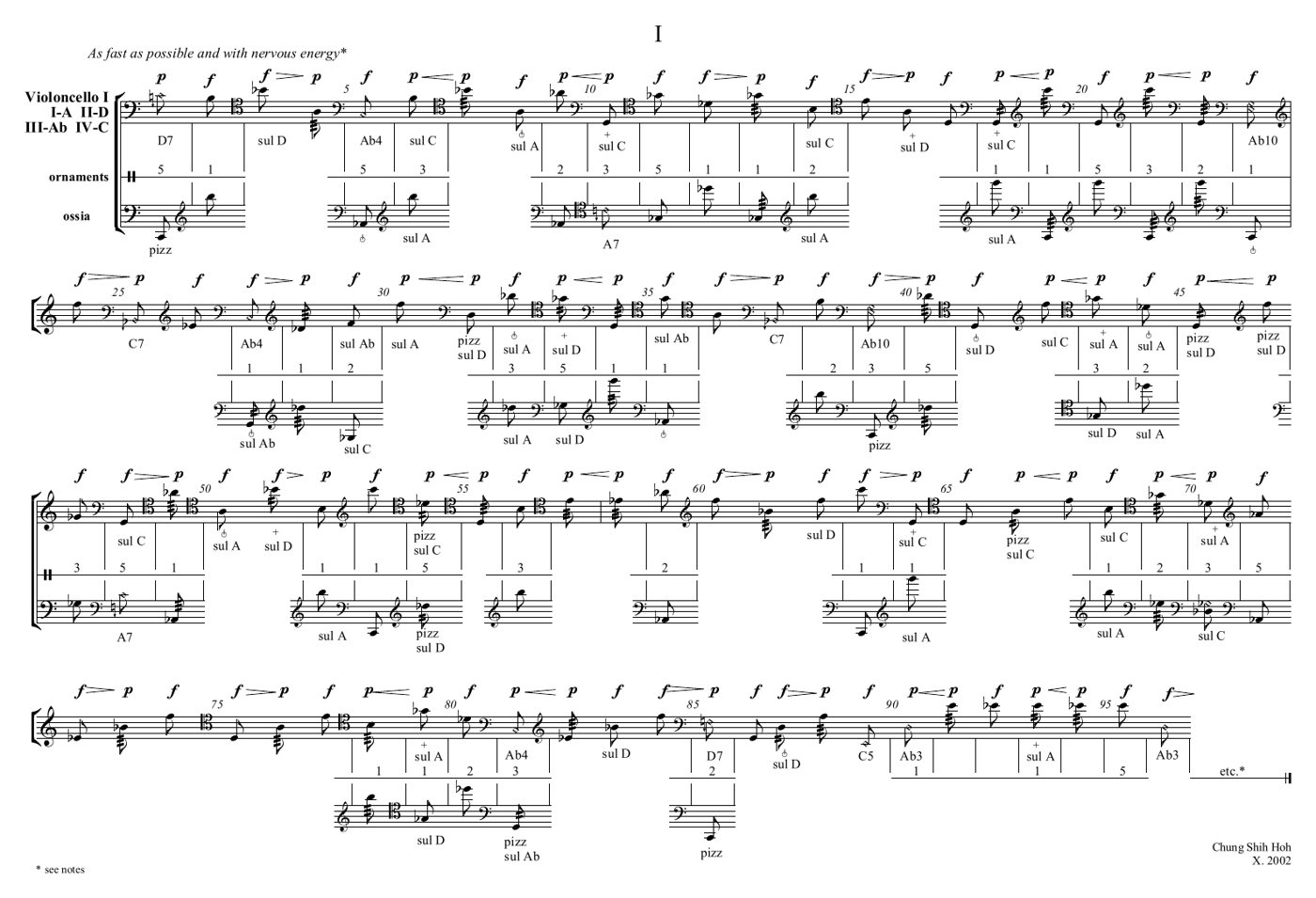
第一大提琴声部的开头,标记为‘尽可能快,带着紧张的能量’。
About the work 关于作品
The title refers to several things at once: the act of open but focused listening the piece requires; a critique of Ives’s work; and the workings of this music. Like the word eavesdropping, broken into parts and rearranged until it arrives at the name of Charles Ives, the music dislocates and transforms itself — and the final transformation invokes a basic tenet of Ives’s music: listening.
标题同时指向几件事:作品所要求的开放而专注的聆听;对艾夫斯作品的一种批评;以及这首音乐本身的运作方式。就像“eavesdropping”(偷听)这个词被拆开、重组,最终变成查尔斯·艾夫斯的名字,音乐也不断地错位与转化——而最后的转化,召唤出艾夫斯音乐的一个基本信条:聆听。
The work is about the dislocation and transformation of similar music between two players and within each part. Played straightforwardly, note against note, the two parts reveal an ‘original’ aural image. But the prescribed techniques, and the effort of overcoming them, make the tempo vary, so the image becomes transformed and dislocated; repetitions at different positions offer different views of the displacement.
作品关于相似的音乐在两位乐手之间、以及每个声部内部的错位与转化。若两个声部直截了当地逐音对齐演奏,便会显现一个“原本的”听觉图像。然而乐谱规定的技法,以及克服这些技法所需的努力,使速度不断变化,于是这个图像被转化、被错置;在不同位置上的重复,则提供了观看这些错位的不同角度。
Each cellist also sings, imitating how the cello sounds and sustaining a vocal pitch that has to be passed from one player to the other. All of this demands very close, attentive listening — to each other and to oneself. The players move between three positions, one of them among the audience.
每位大提琴手同时也要歌唱,模仿大提琴的声音,并维持一个须在两位乐手之间传递的人声音高。这一切都要求极为专注的聆听——聆听彼此,也聆听自己。乐手们在三个位置之间移动,其中一个位于观众之中。
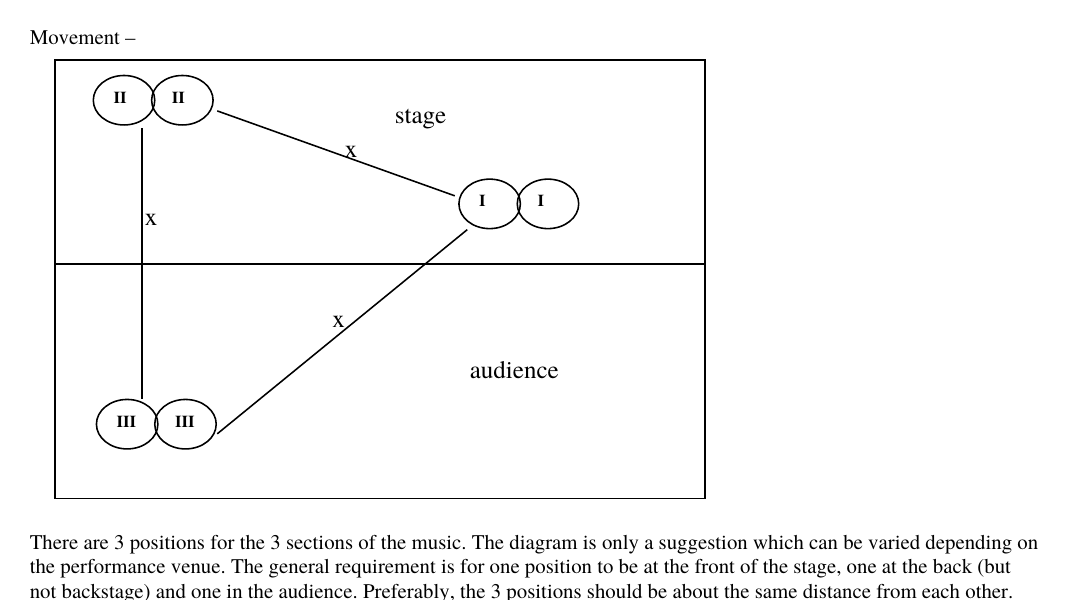
乐手的三个位置与移动路线:两个在舞台上,一个在观众之中。取自乐谱。
Performances 演出
8 December 2003 — first performance: Jonathan Golove and Mary Artmann, Slee Concert Hall, University at Buffalo, New York.
2003年12月8日——首演:Jonathan Golove 与 Mary Artmann,纽约州立大学布法罗分校 Slee 音乐厅。
June 2005 — Jonathan Golove and Mary Artmann, June in Buffalo, USA.
2005年6月——Jonathan Golove 与 Mary Artmann,美国 June in Buffalo 音乐节。
Recordings 录音
完整演出——Jonathan Golove 与 Mary Artmann(大提琴),June in Buffalo,2005年
片段——Jonathan Golove 与 Mary Artmann(大提琴),布法罗大学当代音乐会,2003年
For scores, performance materials and other enquiries:
chungshih@chungshih.info
乐谱、演出资料及其他查询:
chungshih@chungshih.info