Re-veiling Variations
for mixed ensemble and double string quartet · 2004
为混合室内乐团与双弦乐四重奏而作 · 2004
Glossing an earlier work: variations that veil and reveal the music they comment on.
为旧作加注:在变奏中遮掩、又揭示它所评注的音乐。
| Instruments 编制 | Flute, clarinet, bassoon, mandolin or liuqin, viola, woodblocks and glockenspiel, with double string quartet 长笛、单簧管、大管、曼陀林或柳琴、中提琴、木鱼与钟琴,加上双弦乐四重奏 |
|---|---|
| Duration 时长 | ca. 8 minutes 约八分钟 |
| Commission 委约 | Singapore New Music Forum 2004 2004 新加坡新音乐论坛 |
| Premiere 首演 | 6 March 2004 — members of the Singapore Symphony Orchestra, conductor Lim Yau, Victoria Concert Hall, Singapore 2004年3月6日——新加坡交响乐团成员,指挥林友,新加坡维多利亚音乐厅 |
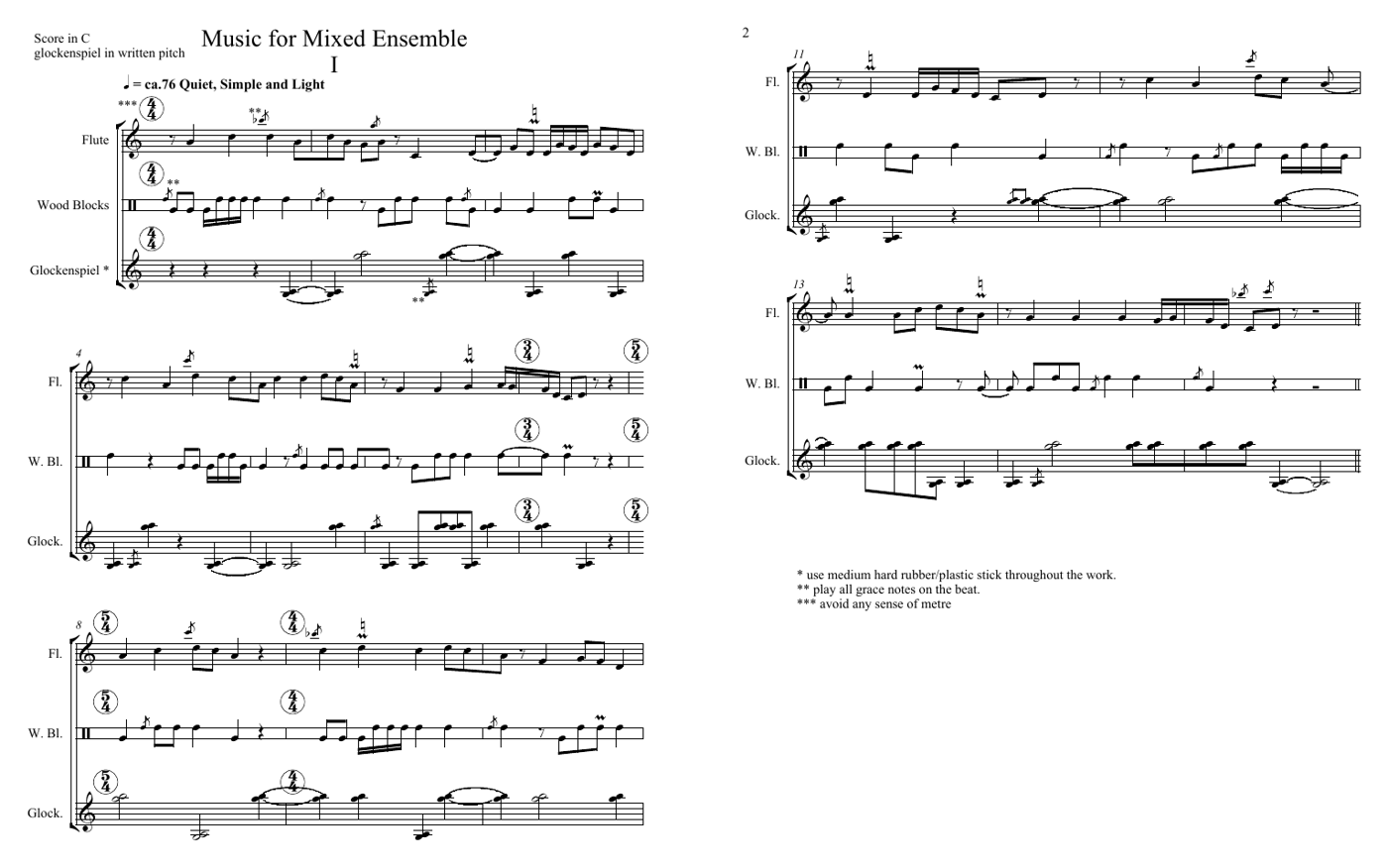
混合室内乐团乐谱的一页。
Programme note 节目介绍
When an object is revealed to us,
certain aspects of the object
are forever lost.
When an object is viewed through a veil,
various aspects never before imagined
are revealed.
当一件事物向我们显露,
它的某些面向
便永远失去。
当一件事物隔着面纱被观看,
种种从未想象过的面向
便显露出来。
This work is based on an early work of mine, Variations (1992), written in response to a request for a set of five variations on a Chinese tune for a mixed ensemble of seven. Re-veiling Variations is a re-viewing of Variations. As if in the tradition of medieval troping, I have added a layer of new music for a double string quartet as elaboration, commentary and clarification on the original music — and through this process I try to understand a work that has not only grown unfamiliar over the years but also remote in its intentions and expressions.
这部作品取材自我早年的作品《Variations》(1992)——当时应邀为七人混合室内乐团,以一首中国曲调写一组五段变奏。《Re-veiling Variations》是对《Variations》的重新审视。仿佛依循中世纪“附加段”(troping)的传统,我为原作加上一层为双弦乐四重奏而写的新音乐,作为对原作的阐发、评注与澄清——并通过这个过程,尝试理解一部不仅多年来已变得陌生、在意图与表达上也已变得遥远的作品。
While this new layer illuminates the original, it also obscures and confuses it, aurally and visually, especially through the spatial arrangement and lighting of the two string quartets on stage. The subject–object relationship between the two musics, and the perspectives of foreground and background, become ambiguous; the audience is constantly confounded by sounds and actions that do not correspond. As I composed, I realised that, much like Jasper Johns’s ‘etchings’ of numbers and Gerhard Richter’s blurred photographs, the veiling procedure itself became the main concern — the ‘theme’ of the new work.
这层新音乐照亮原作,同时也遮蔽、扰乱它——在听觉上,也在视觉上,尤其是透过舞台上两组弦乐四重奏的空间安排与灯光。两种音乐之间的主客关系,以及前景与背景的视角,都变得模糊;观众不断被彼此并不对应的声音与动作所迷惑。在创作过程中,我很快意识到,就像贾斯珀·约翰斯对数字的‘蚀刻’与格哈德·里希特模糊化的照片一样,这种“遮掩”的程序本身成了主要的关注——成为这部新作的‘主题’。
How it is played 演奏方式
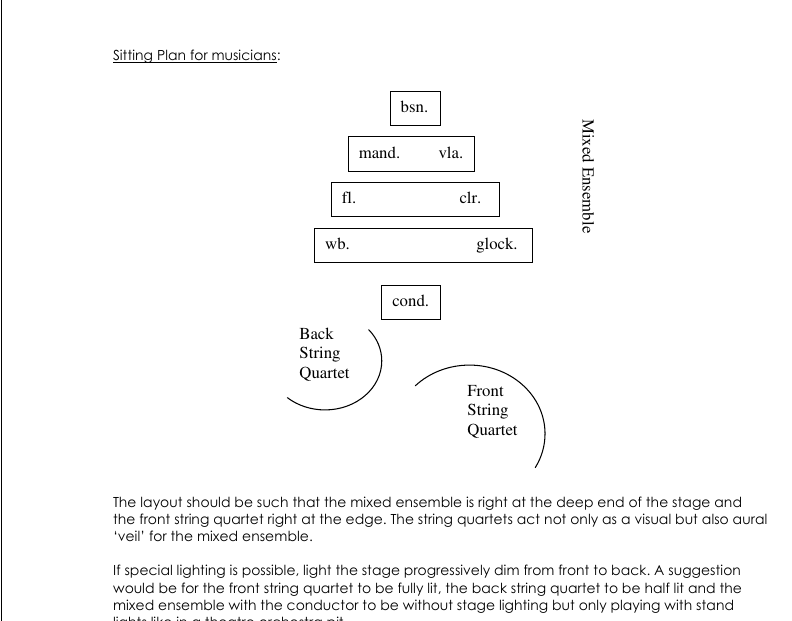
座位图:混合室内乐团位于舞台后方,前、后两组弦乐四重奏在其前方,如一层面纱。
The conductor leads the mixed ensemble through Variations 1 to 5. The double string quartet — a Front and a Back Quartet — forms an independent layer of eight metrically uncoordinated parts, moving through their own sections at their own pace and echoing and pre-echoing the mixed ensemble in a fractured, fragmented way. Their music is hushed but noisy, full of intense activity: ghostly echoes, like signals received from light years away. Energy is never lost but transformed: the mixed ensemble turns what the quartets produce into ‘music’, and the quartets turn the ‘music’ into ‘musical noise’, in an ongoing cycle of dialogue.
指挥带领混合室内乐团演奏第一至第五变奏。双弦乐四重奏——前、后两组——构成一个独立的层次,由八个在节拍上互不协调的声部组成,各自按自己的步调穿过各段落,以破碎、零散的方式为混合室内乐团作回声与预示。它们的音乐极轻却充满杂音与强烈的活动:鬼魅般的回声,如同从光年之外接收到的信号。能量永不消失,只会转化:混合室内乐团把四重奏发出的声音转化为‘音乐’,四重奏又把‘音乐’转化为‘音乐性的噪音’,形成持续不断的对话循环。
Re-veiling Variations is also where independent scores first enter my work: the conductor’s score and the quartets’ music are separate, and the two layers are never aligned beat by beat — an approach that runs through many later works.
《Re-veiling Variations》也是我最早使用独立乐谱的作品:指挥的总谱与弦乐四重奏的音乐彼此分开,两层音乐从不逐拍对齐——这一做法贯穿于此后的许多作品。
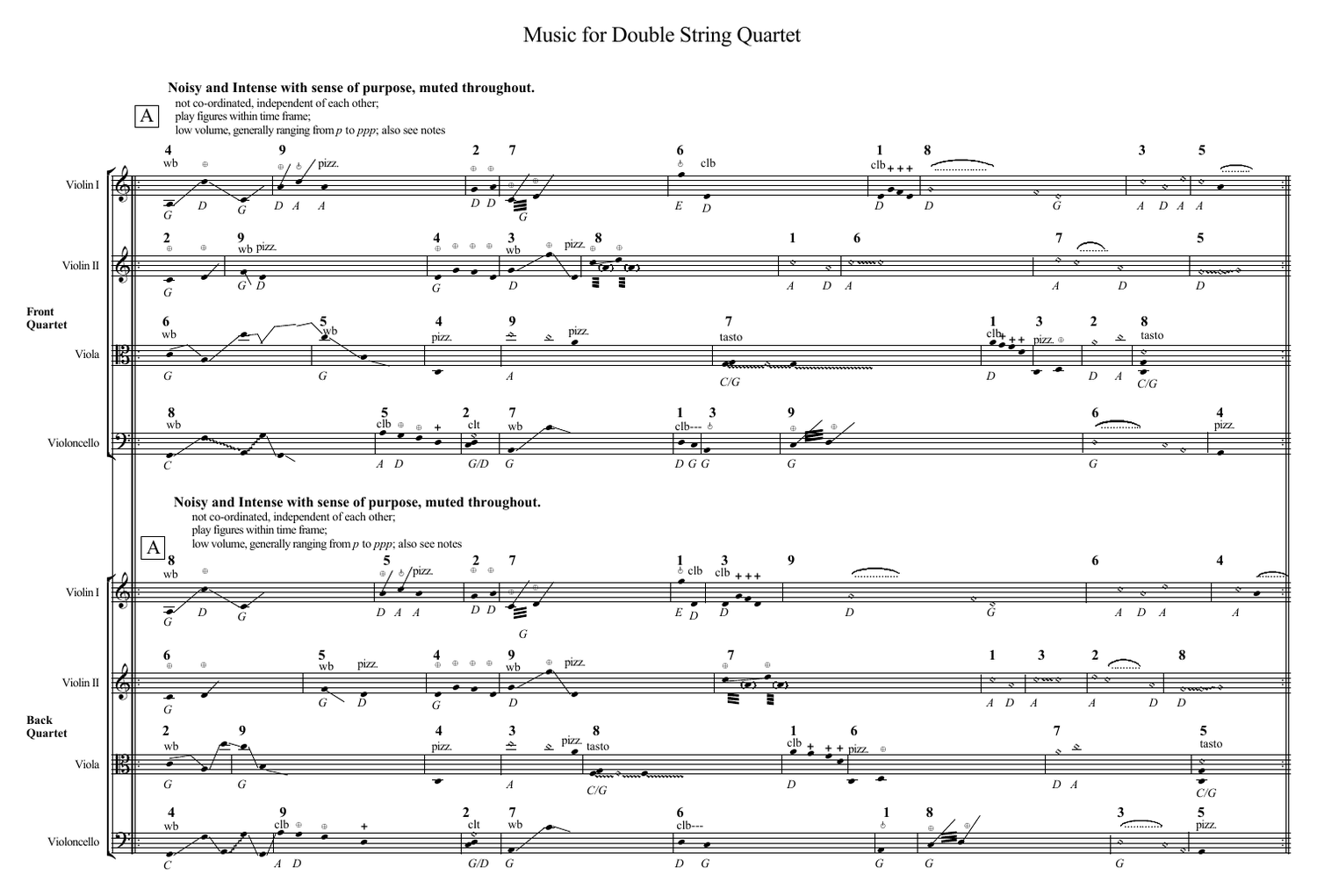
双弦乐四重奏的 A 段音乐:八个互不协调的声部,每小节为以秒计的时间框(粗体数字),因此各声部的小节线从不对齐。
The mixed ensemble sits at the deep end of the stage and the front string quartet right at its edge, so the quartets act as a visual as well as an aural veil. Where possible, the stage is lit progressively dimmer from front to back. For the sound of this layer, I think of an ink painting by Zhang Daqian, in which the lotus is made more vibrant through the veiling of ink splashes, while the splashes themselves are a dynamic mass that ebbs and grows like the eternal, all-pervasive qi.
混合室内乐团位于舞台深处,前方的弦乐四重奏则紧贴舞台边缘,使四重奏在视觉与听觉上都成为一层“面纱”。条件允许时,舞台灯光由前往后逐渐变暗。对于这层音乐的声音,我想到张大千的一幅水墨画:荷花因泼墨的遮掩而更显鲜活,而泼墨本身则是一团动态的墨块,如永恒、无所不在的“气”般消长。
Listen 聆听
完整现场演出:新加坡交响乐团成员,指挥林友,2004 新加坡新音乐论坛
For scores, performance materials and other enquiries:
chungshih@chungshih.info
乐谱、演出资料及其他查询:
chungshih@chungshih.info