述作 (Shuzuo)
for gayageum and flute · 2019
为伽倻琴与长笛而作 · 2019
To transmit and to create: two separate parts, a gayageum and a flute, in a dance of give-and-take.
述与作:伽倻琴与长笛两个各自独立的声部,彼此一来一往地共舞。
| Instruments 乐器 | gayageum and flute 伽倻琴与长笛 |
|---|---|
| First performance 首演 | April 2019 — Jocelyn Clark, gayageum; You-Kyung Kim, flute; ACL-Korea International Conference and Festival, Concert 2: ‘Asian Myths – Combination of Korean Traditional Music and Western Music’, National Gugak Center, Seoul 2019年4月——Jocelyn Clark(伽倻琴)、You-Kyung Kim(长笛);亚洲作曲家联盟韩国国际大会暨音乐节,第二场音乐会“亚洲神话:韩国传统音乐与西方音乐的结合”,首尔国立国乐院 |
About the work 关于作品
故知礼乐之情者能作,识礼乐之文者能述。
作者之谓圣,述者之谓明。明圣者,述作之谓也。
——《乐记·乐论》
‘Those who know the essence of ritual and music can create; those who recognise its forms can transmit. One who creates is called a sage; one who transmits is called enlightened. To be enlightened and a sage — this is what is meant by transmitting and creating.’ (Record of Music, ‘On Music’)
The work explores the interconnectedness between ‘commentary’ on the traditional and ‘creation’ of the new, between ‘interpretation’ and ‘creation’, and between ‘performance’ and ‘composition’.
作品探索对传统的“评述”与新事物的“创作”之间、“诠释”与“创作”之间,以及“演奏”与“作曲”之间的相互联系。
How it is played 演奏方式
The two instruments need not begin or end together, but their four corresponding sections should be roughly equal in length; one player may pause after a section to wait for the other, and endings and beginnings may overlap a little. Each part keeps its own character, tempo and direction — a dance of give-and-take between two separate parts — while the players discover correspondences of gesture, rhythm and timbre that in turn shape their expression. Each prepares a version that makes musical sense alone, then adjusts to the other in rehearsal.
两件乐器不必同时开始或结束,但四个相互对应的段落长度应大致相当;一方可在某段结束后稍作停顿,等待另一方,段落的结尾与开头也可略有重叠。每个声部都保持自己的性格、速度与方向——两个独立声部之间一来一往的共舞——同时,乐手要在两件乐器之间发现姿态、节奏与音色上的呼应,并让这些呼应反过来塑造各自的表达。每位乐手先准备一个独立成立的版本,再在排练中彼此调整。
The gayageum moves from slow and free, slowly establishing a pulse, through very fast gestural groupings on an imaginary irregular pulse and a fast, rhythmic section, to a slow, singing close. The flute begins with very fast bursts of sound, breathy rather than pure, repeating each bar differently ‘as if commenting’ on the gayageum, and ends ‘expressive in a singing manner in duet with gayageum’.
伽倻琴从缓慢而自由、渐渐建立脉动开始,经过在想象中的不规则脉动上极快的姿态性音组,以及一段快速而富节奏的段落,最后以缓慢如歌的段落收束。长笛则以极快、带气声而非纯净音高的“声音迸发”开始,每一小节都以不同方式重复,“仿佛在评述”伽倻琴;结尾则“如歌而富于表情,与伽倻琴二重唱”。
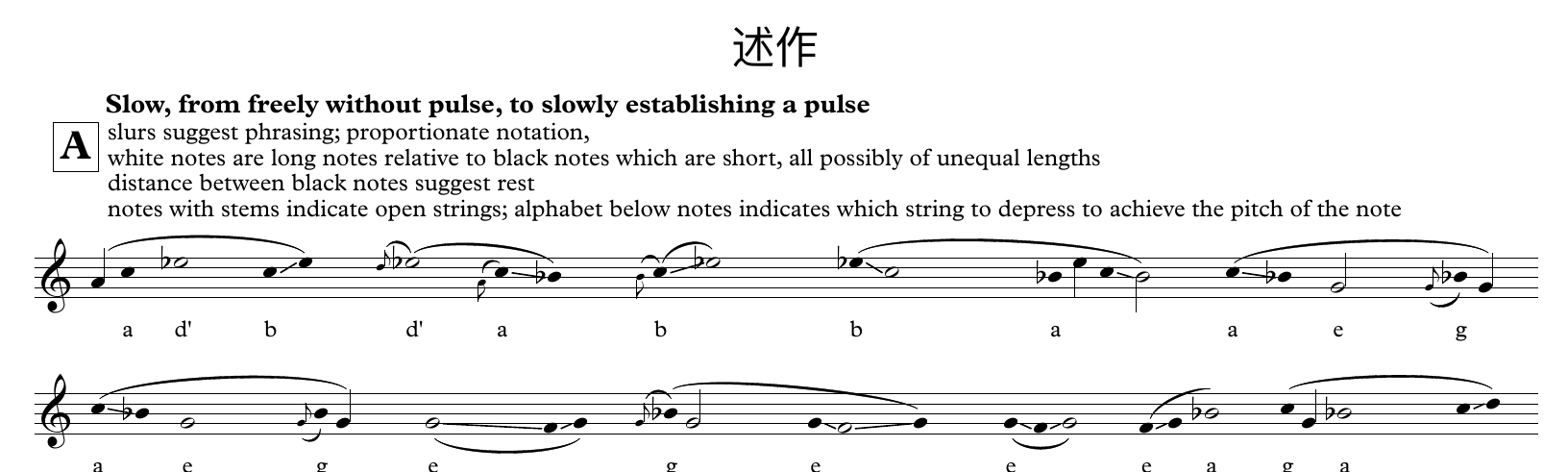
伽倻琴声部 A 段:比例记谱;音符下方的字母表示按压哪一根弦以得到该音高。
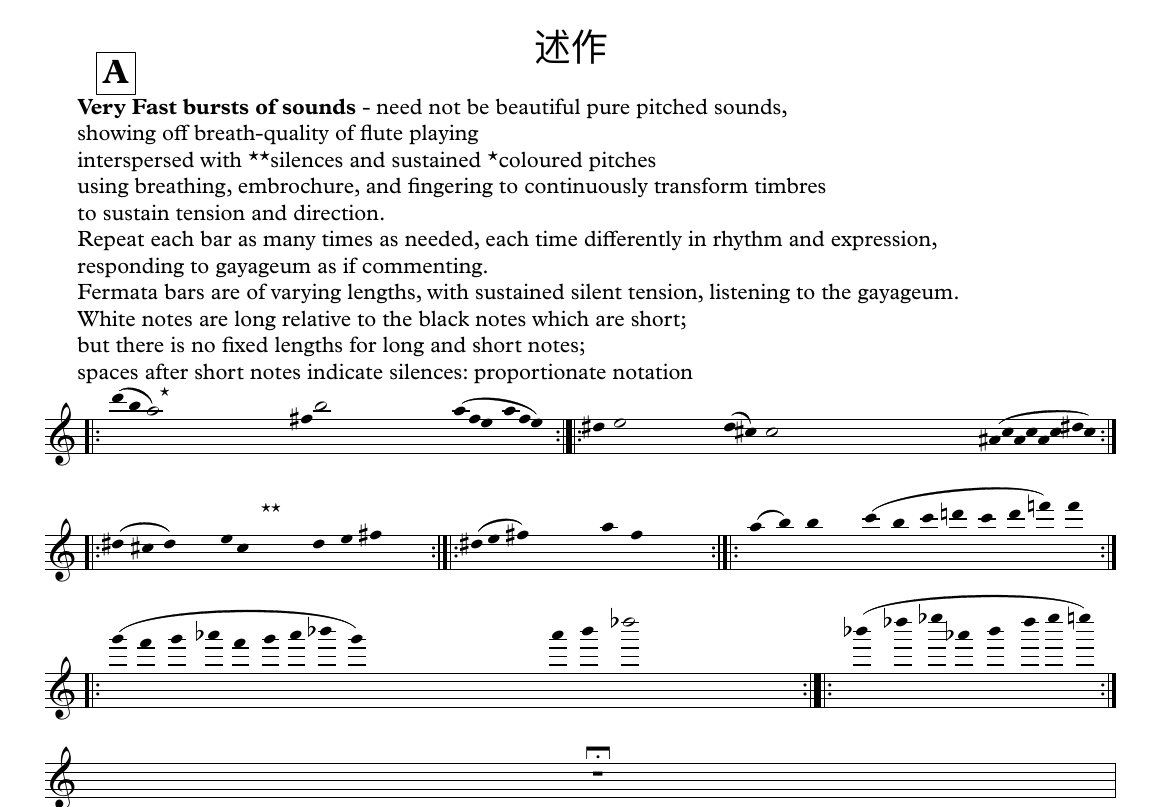
长笛声部 A 段:极快的声音迸发,每小节以不同方式重复,回应伽倻琴。
Performances and talks 演出与讲座
April 2019 — first performance: Jocelyn Clark, gayageum; You-Kyung Kim, flute. ACL-Korea International Conference and Festival (23–26 April), Concert 2: ‘Asian Myths – Combination of Korean Traditional Music and Western Music’, National Gugak Center, Seoul, South Korea.
2019年4月——首演:Jocelyn Clark(伽倻琴)、You-Kyung Kim(长笛)。亚洲作曲家联盟韩国国际大会暨音乐节(4月23日至26日),第二场音乐会“亚洲神话:韩国传统音乐与西方音乐的结合”,韩国首尔国立国乐院。
述作 also gave its name to the composer’s 2019 lecture series 述作, My Music in Singapore, given at Ewha Womans University and Sangmyung University in Seoul, National Kaohsiung Normal University, Taipei National University of the Arts, the Stuttgart Musikhochschule and the Musikhochschule Lübeck.
《述作》也是作曲家2019年系列讲座《述作:我在新加坡的音乐》的题目;讲座先后在首尔梨花女子大学与祥明大学、台湾高雄师范大学、台北艺术大学、德国斯图加特音乐学院与吕贝克音乐学院举行。
For scores, performance materials and other enquiries:
chungshih@chungshih.info
乐谱、演出资料及其他查询:
chungshih@chungshih.info