Parts
a series · 2012–2022
系列作品 · 2012–2022
No full score, only parts: the players find the whole by listening.
没有总谱,只有分谱——整体在彼此聆听中形成。
| Works 作品 | Parts for trombone and piano (2012) Parts for singing flutist (2013) Parts for piano trio (2022) Parts / Yuan for ensembles (2013–15) 《Parts》长号与钢琴(2012) 《Parts》边吹边唱的长笛手(2013) 《Parts》钢琴三重奏(2022) 《Parts / Yuan》合奏版本(2013–15) |
|---|---|
| Listen 聆听 | ▶ Parts for piano trio (video) ▶ Parts for trombone and piano (video) ▶ Parts for singing flutist, in Artistes’ Manifesto, 2014 (video) ▶ Yuan / Parts, SETTS (video) ▶ Yuan / Parts, SETTS, with audience participation (video) ▶ Parts / Yuan, Ensemble Reconsil (Spotify) ▶ 钢琴三重奏版本(视频) ▶ 长号与钢琴版本(视频) ▶ 边吹边唱的长笛手版本,《Artistes’ Manifesto》,2014(视频) ▶ 《Yuan / Parts》SETTS(视频) ▶ 《Yuan / Parts》SETTS,含观众参与(视频) ▶ 《Parts / Yuan》Ensemble Reconsil(Spotify) |
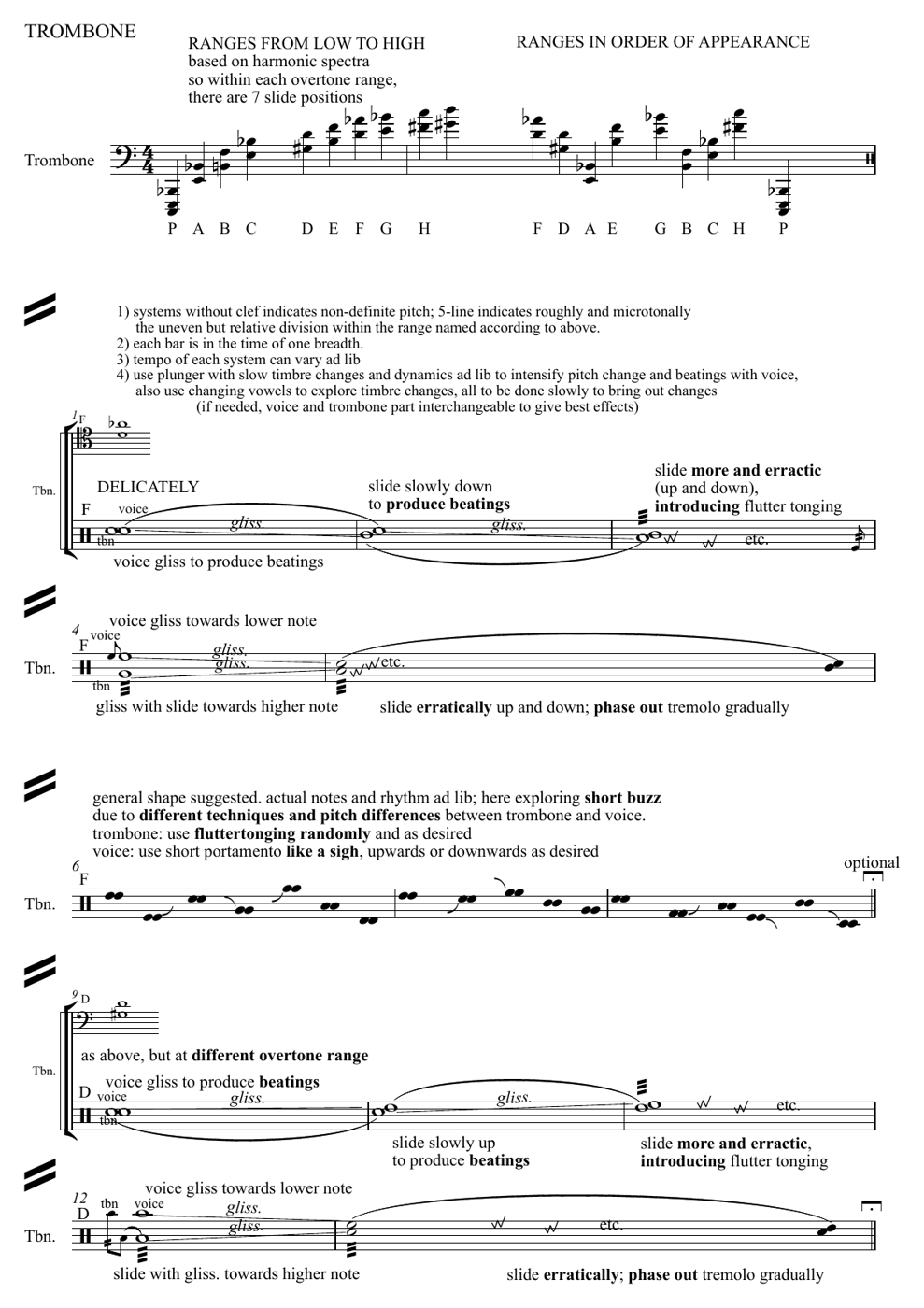
长号与钢琴《Parts》的长号分谱:每小节为一次呼吸;没有总谱。
About the series 关于系列
The title refers both to instrumental parts and to mereology, the study of how parts relate to wholes. Both shape the series: each work is written as independent part-scores with no full score, and the music comes into being as the parts meet in performance.
标题既指乐器的“分谱”,也指“部分学”(mereology)——研究部分与整体关系的学问。两者共同塑造了这个系列:每部作品都由各自独立的分谱构成,没有总谱,音乐在各部分于演出中相遇时才得以生成。
In Parts for trombone and piano, the piano surrounds the trombone with an aura of resonance and answers it. The relationship recalls soloist and accompaniment, but support emerges through listening rather than subordination — a new kind of homophony. Other works in the series look for forms of counterpoint beyond conventional polyphony and heterophony.
在长号与钢琴的《Parts》中,钢琴以共鸣的光晕环绕长号,并对其作出回应。这种关系令人联想到独奏与伴奏,但支撑来自聆听,而非从属——这是一种新的主调音乐。系列中的其他作品,则在传统复调与支声复调之外,寻找新的对位形式。
Parts for piano trio gives violin, cello and piano self-similar materials within a multidimensional time matrix. Canonic structuring, associated in my formation with European practice, coexists with a heterophonic principle I connect to gamelan. Independent strands need a shared sense of pacing — like friends walking together, never marching in lockstep.
钢琴三重奏的《Parts》让小提琴、大提琴与钢琴在多维的时间矩阵中使用自相似的材料。在我的养成中与欧洲作曲实践相连的卡农结构,与我联想到甘美兰的支声原则并存。各自独立的声部需要共同的步调感——如朋友结伴同行,而非齐步行进。
The works 作品
Parts for trombone and piano (2012) — composed for Dirk Amrein and Jürg Henneberger. The two parts are not coordinated in time and need not start or end together. The trombonist sings into the instrument to create beatings between voice and brass, each bar lasting a breath, while the pianist uses black-key figures and wrist clusters on the white keys to envelop the trombone in a resonant aura. ca. 6–8 minutes. ▶ Watch
《Parts》长号与钢琴(2012)——为 Dirk Amrein 与 Jürg Henneberger 而作。两个声部在时间上并不协调,无需同时开始或结束。长号手一边吹奏一边哼唱,使人声与铜管之间产生拍音,每小节的长度为一次呼吸;钢琴则以黑键音型与手腕在白键上压出的音簇,为长号营造共鸣的光晕。约六至八分钟。▶ 观看
Parts for singing flutist (2013) — one player, two parts. The voice interrupts the rhythm, breath and timbre of the flute, and each part tries to keep its own identity while pulling and tearing at the other; noise, air sounds and even silence may result. First performed by Daiske Kinoshita. ▶ Watch (from Artistes’ Manifesto, Odyssey Dance Theatre, 2014, a programme with dance and other works)
《Parts》边吹边唱的长笛手(2013)——一位乐手,两个声部。人声不断打断长笛的节奏、气息与音色,两个声部都试图保持自己的身份,同时彼此拉扯、撕裂;噪音、气声,甚至无声,都可能由此产生。首演:Daiske Kinoshita。▶ 观看(选自 Odyssey 舞蹈剧场 2014 年结合舞蹈与其他作品的演出《Artistes’ Manifesto》)
Parts for piano trio (2022) — written for the International Music Composition Festival 2022, Yogyakarta, and performed there by Athaya Hanan (violin), Radityanwan Gilar Risangaji (cello) and Adi Vijay (piano) at the Institute of the Arts Yogyakarta. Each bar is an open duration, completed differently by each player; sections overlap as the players lead one another on. ▶ Watch
《Parts》钢琴三重奏(2022)——为 2022 年日惹国际作曲节而作,由 Athaya Hanan(小提琴)、Radityanwan Gilar Risangaji(大提琴)与 Adi Vijay(钢琴)在日惹印尼艺术学院演出。每一小节都是开放的时长,由每位乐手以不同方式完成;各段落彼此重叠,乐手们相互引领。▶ 观看
Parts / Yuan (2013–15) — Parts combined with Yuan, in versions for Ensemble Mosaik (2013), Ensemble Reconsil (2015, ▶ listen) and SETTS, with audience interaction (2015). The work travelled through Bangkok, Singapore and Vienna. SETTS: ▶ Watch ▶ With audience participation
《Parts / Yuan》(2013–15)——《Parts》与 《Yuan》 结合,先后有 Ensemble Mosaik(2013)、Ensemble Reconsil(2015,▶ 聆听)与 SETTS(2015,含观众互动)三个版本,足迹遍及曼谷、新加坡与维也纳。SETTS:▶ 观看 ▶ 含观众参与
For scores, performance materials and other enquiries:
chungshih@chungshih.info
乐谱、演出资料及其他查询:
chungshih@chungshih.info