Singing Forgetting
for chamber orchestra · 2005
为室内管弦乐队而作 · 2005
After Zhuangzi’s sitting-forgetting: the orchestra’s own seating becomes the space where the music unfolds.
取意庄子“坐忘”:乐团的座位本身,成为音乐展开的空间。
| Premiere 首演 | 19 April 2005 — Slee Sinfonietta, Lippes Concert Hall, University at Buffalo, New York 2005年4月19日——Slee Sinfonietta,纽约州立大学布法罗分校 Lippes 音乐厅 |
|---|---|
| Listen 聆听 | ▶ Excerpt 1: earlier part — Slee Sinfonietta, premiere ▶ Excerpt 2: middle part — Slee Sinfonietta, premiere ▶ Excerpt 3: ending — Slee Sinfonietta, premiere ▶ 片段一:前段——Slee Sinfonietta,首演 ▶ 片段二:中段——Slee Sinfonietta,首演 ▶ 片段三:结尾——Slee Sinfonietta,首演 |
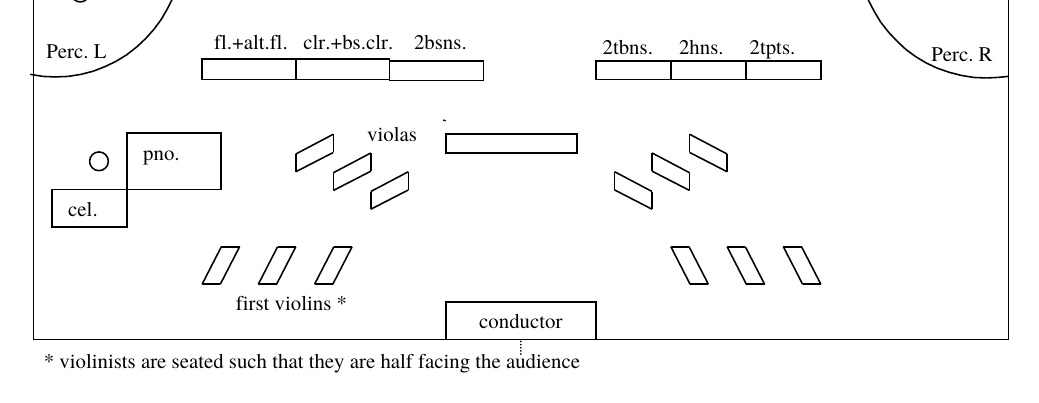
座位图:乐团本身的布局,成为音乐分布其中的空间。
Programme note 节目介绍
The title quotes Zhuangzi’s ‘sitting-forgetting’ (坐忘), adapted to a musical context — hence ‘singing’ instead of ‘sitting’. In Zhuangzi, sitting-forgetting is a meditative state in which one is detached from body and mind and is at one with the Dao; at this level of attainment, one takes part in the transformations of the Great Universe without hindrance.
标题引用庄子的“坐忘”,并改写为音乐的语境——因此以“歌”(singing)代替“坐”(sitting)。在《庄子》中,坐忘是一种冥想的境界:离形去知,与道合一;达到这一境界,便能无碍地参与大化的流转。
I have long been interested in the interaction of time and space in music-making. Through composition I seek to create a musical environment that conditions and allows performers to explore their physical space through performance. In Dragon Singing. Autumnal Waters, for example, the music is generated on two levels: between the performer’s bodily space and the mechanical and acoustic space of the instrument, and between the musical space and the physical space of the whole venue. With the opportunity to write for orchestra, I decided to use the standard orchestral seating plan itself as a physical space in which the music is distributed and its drama played out — left and right, front and back. The Prelude to Act One of Wagner’s Lohengrin provided the initial inspiration.
我一直关注音乐创作与演出中时间与空间的互动。透过作曲,我试图创造一种音乐环境,引导并容许演奏者在演出中探索自身的物理空间。例如在 《Dragon Singing. Autumnal Waters》 中,音乐在两个层面上生成:演奏者的身体空间与乐器的机械、声学空间之间,以及音乐空间与整个场地的物理空间之间。有了为乐团写作的机会,我决定把标准的乐团座位图本身当作一个物理空间,让音乐在其中分布、让戏剧在其中上演——左与右,前与后。瓦格纳《罗恩格林》第一幕前奏曲提供了最初的灵感。
The dramatic tension among groups of instruments in different temporal states is played out: several strands of temporally independent but related music lead to a brief climax before the Epilogue. Numerous fermatas of various lengths, decided independently by the conductor and certain performers, increase the moment-to-moment variables of time, pacing and shape, accentuating synchronicity. This fuzzy environment, with its anticipation of possible outcomes and interaction between performers, comes close to my understanding of the ‘Great Universe’: live interactions among musicians as manifestations of unhindered participation in the transformations of the Dao.
处于不同时间状态的乐器组之间的戏剧张力在此展开:几条在时间上各自独立、却彼此相关的音乐线索,在尾声之前引向一个短暂的高潮。由指挥与部分乐手各自决定、长短不一的众多延长记号,增加了时间、步调与形态上每一刻的变数,突显出“同步性”。这个模糊的环境——对种种可能结果的预期,以及乐手之间的互动——接近我对“大化”的理解:演出中乐手之间鲜活的互动,正是无碍地参与道之流转的体现。
Performances 演出
19 April 2005 — premiere: Slee Sinfonietta, Lippes Concert Hall, University at Buffalo, New York.
2005年4月19日——首演:Slee Sinfonietta,纽约州立大学布法罗分校 Lippes 音乐厅。
14 July 2017 — ADDO Chamber Orchestra, conductor Clarence Tan, Have You Experienced? Concert 1: Music of Our Time, Singapore Chinese Cultural Centre, in a programme with Shostakovich’s Chamber Symphony No. 2 and Nielsen’s Clarinet Concerto. The concert was part of ADDO’s composition laboratory for emerging composers, for which Hoh Chung Shih served as a jury member and mentor.
2017年7月14日——ADDO 室内乐团,指挥 Clarence Tan,《Have You Experienced?》音乐会一:Music of Our Time,新加坡华族文化中心;同场曲目有肖斯塔科维奇《第二室内交响曲》与尼尔森《单簧管协奏曲》。这场音乐会属于 ADDO 为新晋作曲家举办的作曲实验室,何仲实担任评审与导师。
For scores, performance materials and other enquiries:
chungshih@chungshih.info
乐谱、演出资料及其他查询:
chungshih@chungshih.info